Agricultural, food & feed
- Corn / maize
- Wheat
- Barley
- Sugar
- Rice
- Pulses
- Feed ingredients
- Vegetable oils
- Other agricultural commodities
Aqaba · Jordan · Red Sea
Pommer & Partners evaluates rejected, damaged, off-specification and commercially stranded cargo connected with Aqaba — including cargo refused on arrival in Jordan and cargo exported from Aqaba that later encounters problems in another market.
Aqaba is Jordan’s only seaport and works in two commercial directions at once: it receives agricultural, industrial and containerised cargo for the Jordanian and regional market, and it is the export gateway for Jordanian mineral and fertilizer commodities moving to international destinations.
A cargo problem can therefore arise on either side of that flow — on arrival in Jordan, or thousands of miles away, weeks after a vessel has sailed from Aqaba. Pommer & Partners can be approached as a commercial counterparty and, depending on the case, as principal buyer, remarketing counterparty or recovery coordinator.
Where legally and commercially appropriate, we assess direct purchase as principal on an AS IS, WHERE IS basis, alternative buyers, alternative destination markets, remarketing, diversion, onward shipment, commercial recovery, or compliant disposal where no viable market remains. No purchase is promised: every case is subject to commercial evaluation, title, authority to sell and applicable regulation.
Pommer & Partners International Trading Limited is registered in Ireland. Aqaba is described here as a service and recovery market, not as a company location.
Submit an Aqaba cargo case
Send the commodity, quantity, current location and condition. We revert with realistic commercial options.
Submit a Cargo CaseEmail Pommer & PartnersInternational desk · 24/7
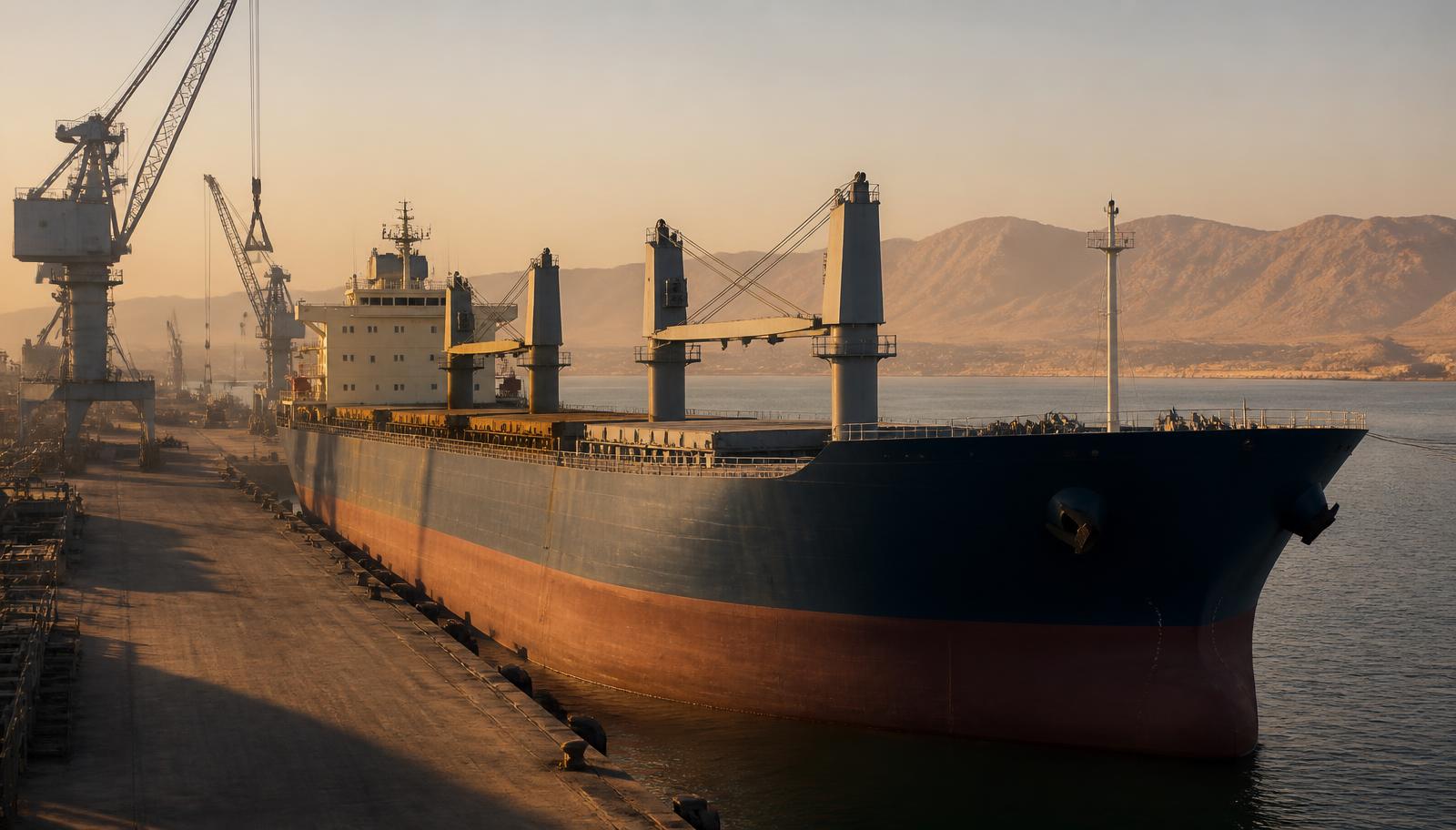
Cargo arriving in Aqaba
Discharge, transfer, handling, repacking, treatment or other local intervention involving rejected cargo may require the approval of customs and, depending on the commodity, of other competent authorities. Those approvals are case-specific and cannot be assumed in advance.
A rejection at Aqaba can leave cargo commercially stranded on board where import is not permitted and no authorised local discharge or handling solution is available.
Where that is the position, the vessel may require an alternative destination and an alternative commercial solution outside Jordan. Pommer & Partners can assess whether another market or another buyer is commercially feasible, and on what basis.
Subject to approvals and feasibility, the routes assessed may include:
Every case remains subject to customs, regulatory, sanctions, food and feed, environmental and destination-market requirements. Whether rejected cargo may be discharged, sampled, repacked, treated or otherwise handled in Aqaba must be determined case by case with the competent authorities.
Situations that create a case
We speak directly to
Inbound Cargo Through Aqaba
The categories below are indicative rather than exhaustive, and do not imply that Pommer & Partners regularly purchases every cargo type listed. Each parcel is considered individually on its condition, analysis, regulatory classification and remaining commercial value.
Rejected agricultural bulk is a recurring theme in Red Sea trade. Related resources: rejected grain cargo buyers, agricultural commodities and feed and Red Sea and Middle East cargo recovery.

Jordanian producers, exporters & traders
Aqaba is also an export gateway for Jordanian mineral and industrial commodities. Cargo leaving the port in apparently sound condition can develop a problem only after the vessel has sailed — during the voyage, on arrival, at the laboratory, or in the receiver’s commercial assessment.
Aqaba origin → international destination → cargo problem abroad → commercial recovery assessment.
In those cases the cargo is no longer in Jordan. It may be lying in India, Southeast Asia, the Mediterranean, Africa, elsewhere in the Middle East or in any other international market — still on board, part-discharged, in a shed, or under dispute. Pommer & Partners can assess such cases as an international commercial counterparty. We do not maintain offices in those countries.
The cargo does not need to be physically located in Aqaba for Pommer & Partners to assess a case connected with an Aqaba exporter or Jordanian cargo interest.
Export commodities commonly moving via Aqaba
Problems arising after export
Written for
Distressed grain, rejected cargo & salvage recovery
Aqaba is Jordan’s maritime gateway and its dry-bulk and grain handling infrastructure carries the country’s imported agricultural commodities. That concentration means a single rejected or off-specification parcel has no local alternative port to fall back on, which is precisely what turns a cargo quality question into a vessel and demurrage question.
The cases we see involve maize and corn, wheat, barley, soy products, feed commodities and other agricultural bulk — with heat damage, self-heating, moisture, mould, mycotoxin findings, specification failure, receiver rejection, regulatory rejection, a cancelled purchase, cargo left stranded on board, or a vessel accumulating delay while the parties consider their position.
A cargo can retain substantial residual value even where the original receiver or the intended market can no longer accept it. The objective is not automatically disposal.
Pommer & Partners evaluates the routes in order: direct purchase as principal, an alternative buyer, a structured salvage sale, regional or international remarketing, a lawful alternative recovery application, and only then compliant disposal. Related commodity resources cover damaged grain & corn salvage and agricultural commodities & feed.
Nothing qualifies automatically. Every route depends on cargo condition and applicable requirements, and must be confirmed for the individual cargo and jurisdiction. Pommer & Partners does not maintain an office, warehouse, silo, terminal or subsidiary in Jordan and holds no local regulatory authority.
Recovery sequence assessed
Shipowners, P&I Clubs, insurers & surveyors
Pommer & Partners works with shipowners, P&I Clubs, marine and cargo insurers, surveyors, claims correspondents and authorised cargo interests on Aqaba-connected files. Where authority to sell the cargo exists, we can be the counterparty on the other side of that sale rather than another adviser added to it.
Subject to the individual case, we can evaluate:
Permission from a P&I Club or insurer does not by itself establish title, and does not override customs, import, environmental or other regulatory requirements.
Authority to sell and legal title must be established for the specific transaction. Where Pommer & Partners purchases, it acts as principal for its own account and is a commercial counterparty, not an independent valuer — any purchase offer is a commercial bid. Depending on the assignment, Pommer & Partners may also manage a salvage sale or coordinate commercial recovery; selected assignments may be undertaken on a No Cure, No Pay basis, subject to the agreed terms. Further detail is set out under marine cargo salvage and our position as distressed cargo buyer.
Roles Pommer & Partners may take
The role applicable to a case is disclosed before terms are discussed, so that the party instructing us knows whether it is dealing with a buyer or with a recovery counterparty.
Where the Jordanian market is closed
Where cargo cannot enter its originally intended Jordanian market, another destination or a re-export route may sometimes be commercially investigated. That is an investigation, not an outcome: Pommer & Partners does not promise that re-export will be permitted, and no route can be assumed before the competent authorities and the receiving market have been addressed for that specific parcel.
Aqaba sits inside a dense recovery geography, which is often what makes an alternative destination realistic. Related markets are covered under Alexandria & El Dekheila, Jeddah, Port Said, Salalah and Djibouti, with the regional picture under Red Sea & Middle East cargo recovery and placement routes under cargo remarketing.
Feasibility depends on
Each factor must be confirmed for the individual cargo and jurisdiction before a route is agreed.
Commercial roles
Coordinates vessel operations, customs procedures, documentation, discharge and local logistics.
Inspects, samples and documents cargo condition, and reports findings to the instructing party.
Takes a commercial position on the cargo itself, where the case supports it.
Neither the agency role nor the survey role automatically means that the party will purchase a rejected cargo or assume the commercial exposure attached to it. Pommer & Partners may instead act, where appropriate, as principal buyer, alternative commercial counterparty, recovery coordinator or remarketing counterparty. Other specialist buyers and traders are active in the same market; no exclusivity is claimed.
How an Aqaba-connected case is handled
Cargo information required
There is no form. Copy the list, fill in what you have and email it directly — incomplete information is still better than a delay.
Submit a Cargo CaseEmail Pommer & PartnersAqaba & Jordan · FAQ
Potentially, subject to the circumstances of the case. Where cargo is not admitted for import and no authorised local discharge, storage, treatment, repacking or commercial solution is available, an alternative destination or commercial recovery route may be assessed. Any route remains subject to customs, regulatory, sanctions, food and feed, environmental and destination-market requirements.
Yes. An initial commercial assessment is frequently possible from the available documentation, survey findings, laboratory data, photographs and the current vessel and port status, subject to case-specific requirements and verification.
Yes, cases can be assessed even where the cargo has already left Jordan and is physically located in another market such as India, Southeast Asia, the Mediterranean, Africa or elsewhere in the Middle East. The cargo does not need to be in Aqaba for a case connected with an Aqaba exporter or cargo interest to be reviewed.
Agricultural bulk, food and feed commodities, fertilizers, minerals, industrial raw materials and other commercial cargoes can be considered, subject in each case to condition, analysis, title, regulatory classification and commercial feasibility.
Pommer & Partners handles international cargo cases through its trading and recovery network. The Aqaba page describes service capability for cargo connected with the port and Jordanian trade; it does not represent a physical Pommer & Partners office in Aqaba.
Pommer & Partners can be approached directly as a buyer of distressed grain and agricultural bulk connected with Aqaba, including parcels still on board, part-discharged or held pending a decision. Depending on the case we may purchase as principal on an AS IS, WHERE IS basis, place the cargo with an alternative buyer, run a salvage sale or remarket it internationally. Which route applies depends on cargo condition, laboratory analysis, title, authority to sell, regulatory position and logistics.
Rejected maize and corn parcels arriving at Aqaba can be evaluated by Pommer & Partners for direct purchase or another commercial recovery route. The realistic options depend on why the cargo was rejected — a documentary or contractual failure, a moisture or mould finding, self-heating, or a mycotoxin result are commercially very different starting points, and each is assessed on the survey and laboratory evidence rather than on the commodity alone.
Yes, vessel-size parcels are within scope, including full cargoes. Acceptance depends on the commodity, quantity, cargo condition, current vessel and port status, documentation, ownership and title, regulatory position and the commercial economics of the individual case. No purchase is promised before the case has been reviewed.
Commodity; quantity; vessel and current port or anchorage status; origin and intended receiver; the reason for rejection; the rejection, detention or authority notice where available; the written P&I or insurer authority; survey report; laboratory report or certificate of analysis including moisture, temperature and mycotoxin data where applicable; photographs; customs status; the party entitled to sell and the basis of that entitlement; and the decision timeframe. Where anything is missing, send what exists — the assessment can usually begin on partial information.
Frequently, yes. A refusal by the contractual receiver, or a rejection from the intended Jordanian market, does not by itself establish that the parcel has no remaining commercial value. An alternative buyer, an alternative destination, a salvage sale or another lawful commercial use may still be available, subject to regulatory and technical acceptance and to the condition the cargo is actually in.
Potentially. Whether cargo can move to a buyer outside Jordan depends on its customs status, the reason for rejection, cargo condition and laboratory results, vessel status, ownership and title, the contractual position, acceptance by the destination country, transport economics and the regulatory classification of the material. Pommer & Partners cannot promise that re-export or an alternative destination will be permitted; feasibility must be confirmed for the individual cargo with the competent authorities and the relevant service providers.
Sometimes, and the answer turns on severity and analysis rather than on the fact of heat damage. A limited heat-affected area in an otherwise sound stow and a parcel with a contamination or mycotoxin finding lead to very different outcomes. Heat-damaged agricultural cargo does not automatically qualify for feed, crushing, biodiesel, biomass or biogas; each intended outlet has its own technical and regulatory requirements that must be confirmed for that material.
Where food and feed use is not available, alternative industrial, material or energy-recovery routes may be evaluated where they are legally and technically permissible in the relevant jurisdiction. Compliant disposal is considered only once no commercially and legally viable recovery route remains. Pommer & Partners does not make blanket statements about disposal at sea, and treats disposal as the final position rather than a starting assumption.
By putting the commercial question in parallel with the regulatory one instead of after it. While the rejection, customs position and survey are being resolved, an initial commercial assessment can usually proceed on the available documentation, survey findings, laboratory data, photographs and current vessel status — so that if an alternative buyer, alternative destination or purchase route is realistic, it is already identified rather than being started once the delay has accumulated. For rejected grain or off-specification fertiliser connected with Aqaba, provide remaining quantity, berth or anchorage status, storage availability and the reason discharge is blocked. Grain analysis and food/feed restrictions differ from fertiliser specification, safety data and permitted industrial or agricultural use. Pommer & Partners compares realistic discharge, storage and onward-sale routes after handling and freight costs. Rejection does not establish waste status, and a sale does not itself clear cargo or extinguish vessel, terminal or carrier liabilities. Assessing rejected grain remaining on board.
Depending on the case, Pommer & Partners can act as principal buyer, salvage buyer, salvage sale and remarketing partner, recovery coordinator, or recycling and disposal coordinator. The role is disclosed for the individual case. Where Pommer & Partners is itself the buyer, it acts as a commercial counterparty for its own account and not as an independent valuer, and any offer made is a commercial bid rather than an independent valuation.
Regulatory references on this page are general information and not legal advice. Requirements applicable to a specific cargo must be confirmed with the competent authority or a qualified adviser before a route is agreed.
Related capabilities
Trust & compliance
Transactions and services are subject to verification and applicable regulation, including:
Purchases and sales require evidence of ownership and authority to sell, or the written authority of the insurer or party entitled to dispose of the cargo. Recovery, recycling and disposal routes depend on waste classification and on applicable environmental, transport and customs rules in the countries involved. Potential alternative use of food or agricultural cargo, including animal-feed applications, depends on cargo condition, laboratory results and applicable food and feed legislation, and is only pursued where the competent authorities and the relevant rules allow it.
Pommer & Partners can act as buyer, principal or recovery specialist for distressed cargo connected with Aqaba and internationally. See Choosing a cargo recovery company and Insurance salvage.
Related
We buy damaged, rejected and abandoned cargo as principal, AS IS, WHERE IS.
How cargo recovery companies, consultants and salvage buyers differ.
Buyers & recovery specialists worldwide.
Worldwide buyers of abandoned, unclaimed and stranded cargo.
Solutions for cargo inside abandoned and unclaimed containers.
Shipments never collected or claimed by the consignee.
Consignments refused on arrival by receivers or authorities.
Salvage sales and cargo recovery at sea and in port.
Solutions for rejected and off-specification consignments.
Wet, contaminated and heat-affected consignments.
Distressed grain, feed and vegetable oils.
Damaged, rejected and off-spec agricultural commodity salvage.
Grain, corn and maize cargo damaged or rejected at destination.
Cargo recovery across the Red Sea, Gulf and East Africa.
International salvage sales and buyer placement.
Material and energy recovery routes.
When no commercial market remains.
How cargo cases are structured and resolved.
Submit cargo details
Send us the cargo details, location, quantity, condition and available survey information for an initial assessment.
contact@pommerpartners.com